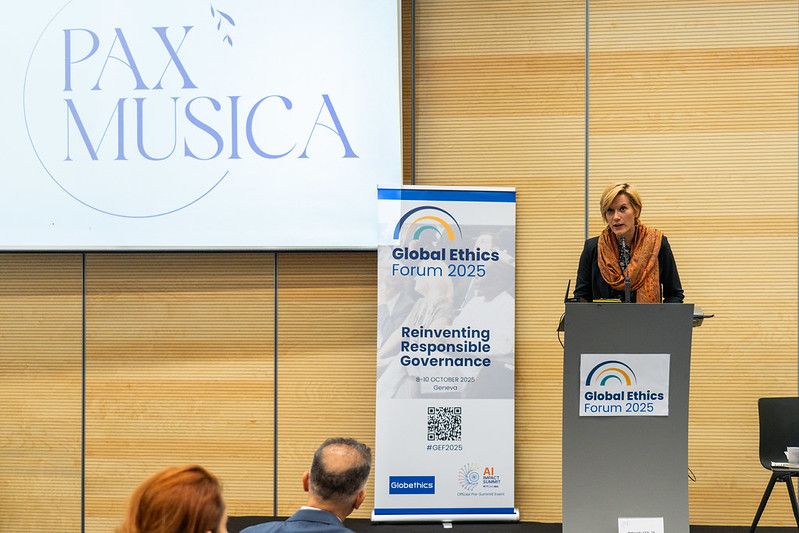
À la clôture du Global Ethics Forum 2025 à Genève, une conviction est restée à Hélène Daccord : avant de jouer la politique, il faut accorder la salle.
Au cœur du quartier des Nations unies, parmi des dirigeants et des penseurs venus de 39 pays, PAX MUSICA a eu l’honneur d’offrir sa voix — non par des discours, mais par la musique.
Les musiciens de PAX MUSICA — d’Arménie, d’Ukraine et du Kurdistan — ont joué aux côtés de leurs mentors français, pour le premier concert international de l’académie. Plus qu’une performance : un dialogue entre des mondes qui se rencontrent rarement, entre l’exil et l’espoir, entre la mémoire et l’avenir.
Dans son intervention « La musique : une troisième voie diplomatique ? », inspirée de son livre Quand la musique fait l’histoire (Passés Composés, 2023), Hélène Daccord a exploré comment la musique peut ouvrir un espace au-delà du hard et du soft power — une troisième voie, comme la tierce dans un accord :
Une note est un monologue. Deux notes s’opposent souvent. La tierce, elle, permet aux différences de tenir ensemble.
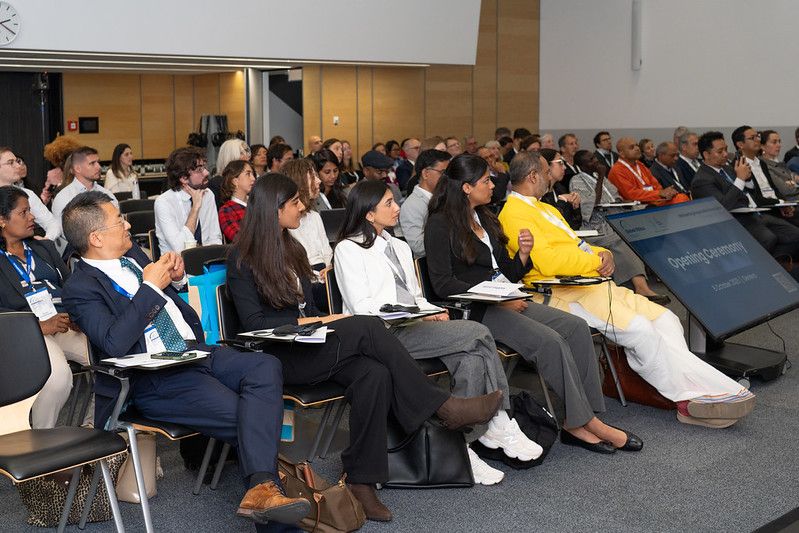
La tierce libère la musique. La musique n’éteint pas le conflit : elle ouvre des portes. Elle écoute, elle explique, elle bâtit des ponts.
De la Neuvième Symphonie de Beethoven — une même partition revendiquée par des régimes, des manifestants et des artisans de paix — au triomphe de Van Cliburn à Moscou au plus fort de la guerre froide, jusqu’à Rostropovitch jouant Bach au pied du mur de Berlin : l’histoire rappelle que la musique est depuis longtemps un acteur diplomatique, un petit intervalle qui transforme le bruit en accord.
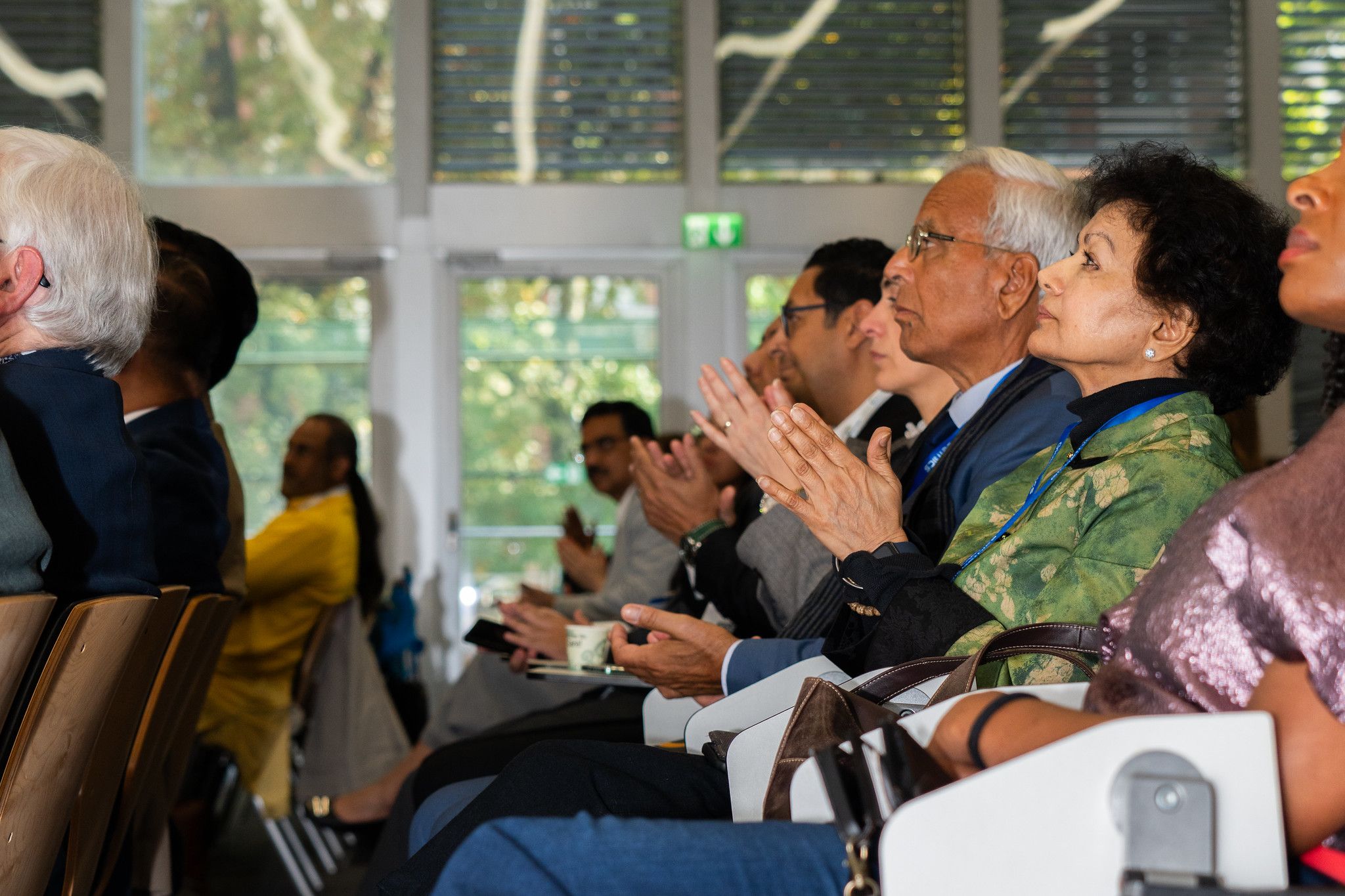
Elle a remercié Globethics et Fadi Daou d’avoir osé réunir éthique, culture et gouvernance dans une même conversation — et d’avoir invité PAX MUSICA à porter cette harmonie au cœur des Nations unies.
Puissions-nous être la tierce dans la salle — le petit intervalle qui transforme la dissonance en harmonie.
Le texte de l’intervention
Texte intégral de l’intervention d’Hélène Daccord, prononcée en anglais lors du concert d’ouverture du Global Ethics Forum 2025 (Genève, 8 octobre 2025).
Good evening, and thank you, Globethics, for convening a forum that dares to reinvent responsible governance. Thank you, dear Fadi, for the invitation.
I’m delighted to introduce this concert by Pax Musica, an NGO and academy that supports musicians who have found refuge in a new country, through mentorship alongside renowned performers. Pax Musica gives concerts worldwide, sharing a message of peace and dialogue through music, and building bridges of solidarity wherever harmony is fragile.
Tonight, we will hear “The Song of the Birds” by Pablo Casals, a musician who, like many today, found his voice far from home. Casals said that when he played this piece, he thought of peace, of freedom, and of the sky that belongs to everyone.
Among Pax Musica’s artists are musicians from Armenia, Ukraine, and Kurdistan. Their music reminds us that every sound shared is already a step toward peace.
As the founder of Pax Musica and the author of Quand la musique fait l’histoire, I would like to offer a brief reflection on music as a “third way” of diplomacy, beyond hard power, and beyond mere soft power.
In French, we call the interval that makes a chord la tierce, the third. One note is a monologue; two notes often pull against each other; the third lets differences hold. The third unlocks music.
Tonight I want to speak about music and cultural diplomacy as that third way, a space where distinct notes can resonate without cancelling each other. Music doesn’t extinguish conflict; it opens doors. Cultural diplomacy is the third that turns sound into accord. That’s the tierce.
The art of the third can be learned in three movements, listening, explaining, and bridging, the gestures that turn dissonance into harmony. Our third way begins not by speaking, but by listening, together.
1. Listen
Cultural memory can precede political compromise, another third way. A shared repertoire gives adversaries a language to imagine coexistence.
Consider Beethoven’s Ninth. This piece is a real “carousel of appropriations”: the same score has served opposed political narratives, performed by Nazi Germany to glorify unity through domination, by protesters in Tiananmen Square to cry for freedom, by Bernstein in Berlin to celebrate the fall of a wall, and by the European Union today to symbolize peace. One work can host competing meanings, room enough for dialogue.
Shared symbols survive because they can be read differently without breaking, that’s what the third allows. It’s not a consensus; it’s shared listening, a common space of dialogue. That’s the tierce.
2. Explain
In times of conflict, music does not “negotiate”, it “explains” what words can’t. It builds a corridor of attention, dignity, and resolve that politics can later walk through. It’s not a peace deal; it’s the space in which peace becomes imaginable.
Consider Van Cliburn’s performance at the Tchaikovsky Competition in Moscow, 1958. An American pianist, on Soviet soil, at the height of the Cold War. When the jury hesitated, Khrushchev asked: “Is he the best?”, “Yes.”, “Then give him the prize.” For a brief moment, the applause bridged two systems that had stopped speaking. The third was not compromise, but recognition of shared integrity.
Explaining is not just about words; it’s about making meaning visible. Culture helps leaders frame complexity in human terms. What we explain today shapes tomorrow’s agreement. Like musicians, take the time to tune yourselves.
3. Bridge
Artists are ambassadors of nations that don’t yet exist, the imagined communities policy must catch up with.
Remember Rostropovich at the Berlin Wall, playing Bach. A plastic chair at Checkpoint Charlie, Bach in the open air, cameras rolling. He represents neither East nor West, but the reconciliation both sides craved; the world watches, and political space widens.
From Verdi’s Risorgimento to Wagner’s German imaginary, artists voiced nations-in-becoming, before unification. Artists often voice the polity before the passport is printed. This is soft power at human scale, credibility earned by presence, not posture. That’s the tierce.
To conclude: the tierce is not the loudest note; it is the enabler of harmony. If you remember only three words, let them be these: Listen. Explain. Bridge.
In a world tugged between force and façade, music offers a third way for diplomacy: it trains us to hear what is there, to make meaning visible, and to build ties that outlast the moment. May we be the third in the room, the small interval that turns noise into accord. That’s the tierce.